Date: Tue, 26 Mar 1996 08:47:05 +0100
From: Hans Riesel <riesel@nada.kth.se>
To: luke@scruznet.com
Subject: 2^3217-1
Dear Luke,
Thank you for your email! I have visited
https://primes.utm.edu/mersenne/LukeMirror/biblio.htm and looked at the biography you
have compiled. I found a misprint in ref. [27]. It says M3117 instead of
M3217. I also have some material I could send you by paper mail: A copy of
the original paper in Math.Comp. where I first announced M3217, which you
seem to have missed in your bibliography, a photo of BESK (or at least of
a very similar computer), which was one of half a dozen or so copies of the
so-called Princeton machine. It had a cycle time of 14 microseconds, an
add time of 56 microseconds and a multiplication time of 40 bit words of
356 microseconds. Its random access memory consisted of 512 words of
cathode ray tubes Williams memory. It had miniature radio vacuum tubes for
the control circuitry and the arithmetic operations. The programs were at
the time written in absolute machine code, i.e. not even the simplest
compiler for fictitious addresses was available. Nobody, I think, had in
the fifties any correct ideas of how the technique would evolve; I think one
of the major surprises was the hand-held calculator.
I have one anecdote that might interest you. At the same time as I was
searching for Mersenne primes above M2281, so was John Selfridge. We both
saved the last residues mod M_p, I in hexadecimal form, he in octal form
(he was running on some IBM computer, perhaps 704). We met in Stockholm at
the ICM 1962, and could compare the last words of our residues. It turned
out that two pairs differed; John reran those, and one of mine and one of his
original computations had come out in error.
[rest of email deleted]
Kindest regards,
Hans Riesel
|
|
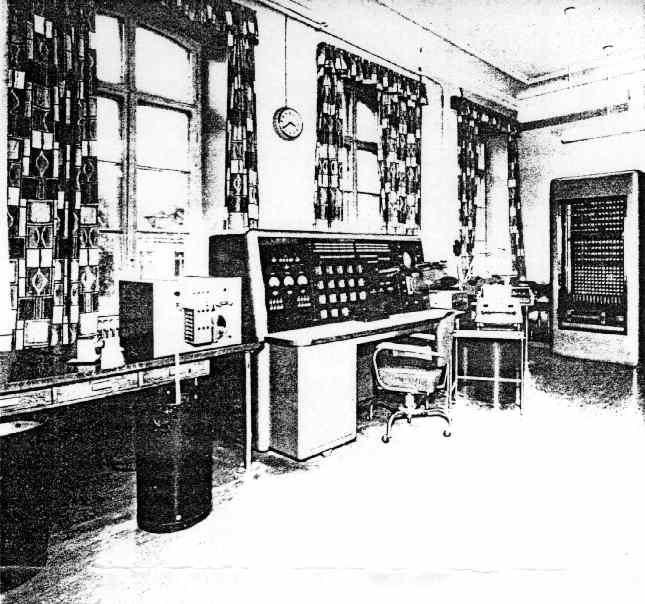
BESK Operator's Panel -- From left to
right: paper tape reader, console with lamps and buttons, paper tape punch,
typewriter, iron oxide drum memory. Note wastepaper baskets under reader and
punch. The birth of Garbage In, Garbage Out?
|
Date: Thu, 28 Mar 1996 14:20:33 +0100
From: Hans Riesel <riesel@nada.kth.se>
To: luke@scruznet.com
Subject: Old times
Dear Luke,
Today I will send you some material by papermail The top photo shows the
operator's panel at BESK. To the left is a 5-track paper tape reader, which
we used as input device. Then comes the console, with control lamps and
buttons. Next you can see a small paper tape punch for output and a
typewriter for control output. The cupboard in the front is a iron oxide
drum for 8192 words of 40 bits each.
Yes I have met the Lehmers a few times over the years. The first time was
in Edinburgh in 1958, last time in their home in Berkeley in 1986.
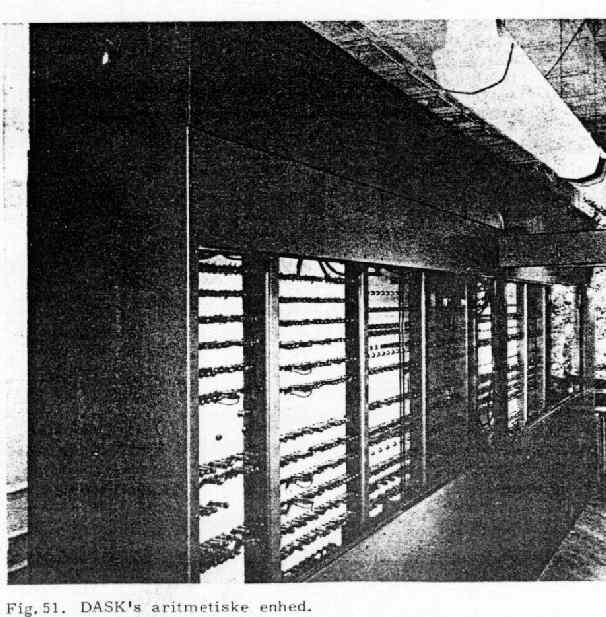
The bottom photo shows the arithmetic unit and control unit of the Danish
computer DASK, similar to BESK. I know of the following machines, made
after the Princeton computer as a concept. SWAC, BESK, the Swedish SMIL (in
Lund), BESM (in the Soviet union). There were also a few commercial copies,
SARA (by SAAB at Linköping) and Facit EDB (sold by Atvidaberg's Industries,
also Swedish). Later there were built a couple of transistorized versions,
called TRASK, by a private firm in Stockholm.
Actually, during its first three weeks, BESK was the fastest computer on
this planet. But when the index registers were attached to SWAC, the SWAC
ran faster.
The programming for BESK was done on paper sheets. We used the notation
ABCDEF for hexadecimal 10-15. Yes, data and program shared memory. We had
self-modifying codes from the very beginning (since we had no index registers,
we had to use programmed address modification to be able to access all
elements of an array e.g.)
Yes, I would say that if you in the sixties had told people that there soon
would be a time, when the logarithm of 2 would be recomputed from scratch,
each time somebody needed the value, nobody would have believed you.---Think
of all the effort put into various function tables in the beginning of the
computer area. Nobody uses those tables anymore!
The errors in the early testing of Mersenne numbers occurred in the BESK
most certainly in the CRT (William's) memory. There was an effect the
technicians called "read around" that meant that electrons were splashing
around a memory location, when the bit in this memory location was changed
with high frequency. This caused adjacent bits in the CRT to change
inadvertently. I don't know anything about the errors in the 704. Yes, we
had a separate multiplication unit in BESK. Parity checking was not
introduced in these old computers.
Kindest regards,
Hans Riesel
![[Back Arrow Button]](../images/back.gif) back to Luke's Mersenne Page
back to Luke's Mersenne Page
![[Home Button]](../images/homeicon.gif) way back to Luke's Home Page
way back to Luke's Home Page